
Induction Brazing Under Protective Atmosphere
Induction Brazing Under Protective Atmosphere Services
Precision induction brazing in a controlled, oxide-free environment
For applications where surface quality and joint integrity are critical, we perform induction brazing under a protective (shielded) atmosphere. This prevents oxidation during heating, eliminates the need for flux, and produces clean, high-strength joints — ideal for components that must meet strict quality or hygiene standards. Combined with our precise temperature control, this process delivers consistent, repeatable results even for demanding materials and geometries.
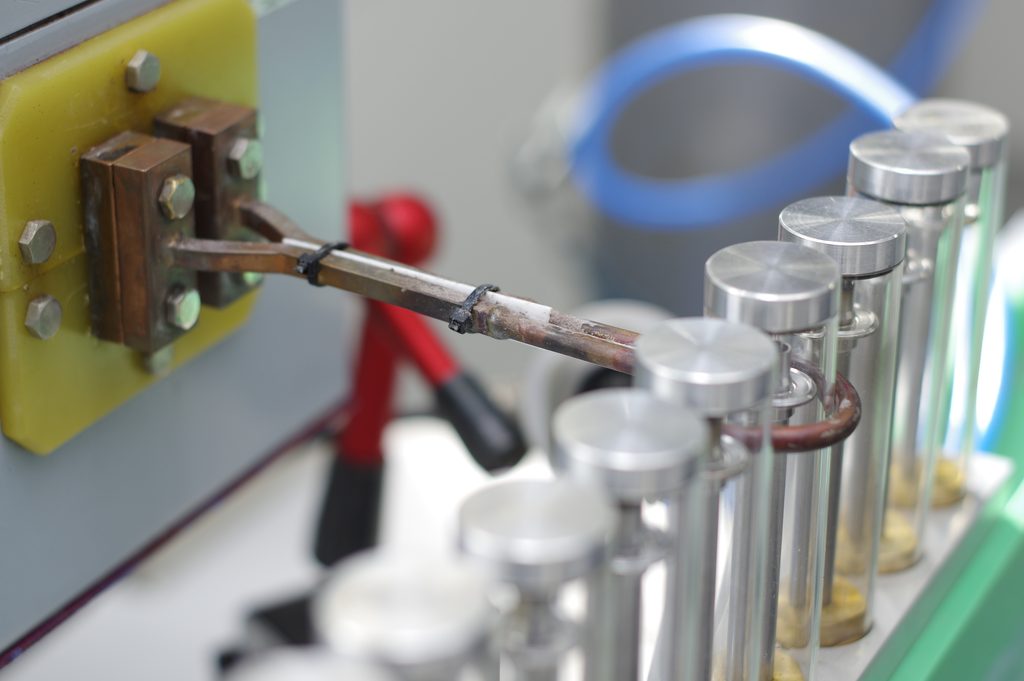
Oxide-Free Joints
Brazing under protective gas eliminates surface oxidation, so joints stay clean without additional post-processing.
Flux-Free Process
No flux residues to clean afterward — ideal for components with tight tolerances or hygiene requirements.
Consistent Repeatability
Controlled atmosphere and precise temperature monitoring ensure reliable, repeatable results across every batch
Talk to our brazing specialist.
Have a question about induction brazing or need a tailored quote? Get in touch – we’re happy to discuss your requirements.
Protective-atmosphere induction brazing replaces flux with a controlled gas environment — typically argon, nitrogen or a reducing atmosphere such as hydrogen — that keeps oxygen away from the joint while it heats. Because no oxide layer forms in the first place, there is nothing for flux to remove, and the finished part needs no post-braze cleaning to strip flux residue. See our brazing glossary for a full explanation of brazing atmospheres and how they compare to open-air and vacuum brazing.
When to Choose Protective-Atmosphere Brazing
This process is the right choice whenever a joint has to stay visually clean and chemically inert straight off the line — components for medical devices, food and beverage equipment, instrumentation, and any assembly where flux residue or discoloration would be a defect rather than a cosmetic issue. It also suits parts with joint geometries that trap flux and are difficult to clean afterward, such as internal channels or blind holes, where residual flux could contaminate a downstream process or a fluid path. Because heating stays localised through the induction coil, cycle times remain short even without the atmosphere step adding significant overhead, so the process is production-viable, not just a lab technique.
Protective Atmosphere vs. Vacuum Brazing
Both protective-atmosphere and vacuum brazing avoid flux, but they suit different production setups. Vacuum brazing needs a furnace and batch-loads parts, which favours larger volumes with longer cycles; protective-atmosphere induction brazing heats one part or fixture at a time, in seconds rather than a full furnace cycle, and integrates more easily into a series-production flow with shorter lead times per batch. If you’re not sure which fits your part and volumes, send us your drawing and we’ll recommend the right process.
As with all our contract brazing work, protective-atmosphere induction brazing runs under our ISO 9001:2015 quality management system, certified by DEKRA Certification GmbH, with process parameters — atmosphere composition, temperature profile, cycle time — documented per batch. It’s one of four core processes we offer at Armin Hain, alongside standard induction brazing, flame brazing and PCD/CBN/PCBN brazing; see our brazing FAQ for more on how we choose the right process for a given part.
Don’t need the protective-atmosphere variant? Our standard induction brazing services page covers the general process, typical applications and cycle times.