
BRAZING MATERIALS & FILLER METALS
Brazing Materials & Filler Metals
Braze alloys, solders and fluxes matched to your application
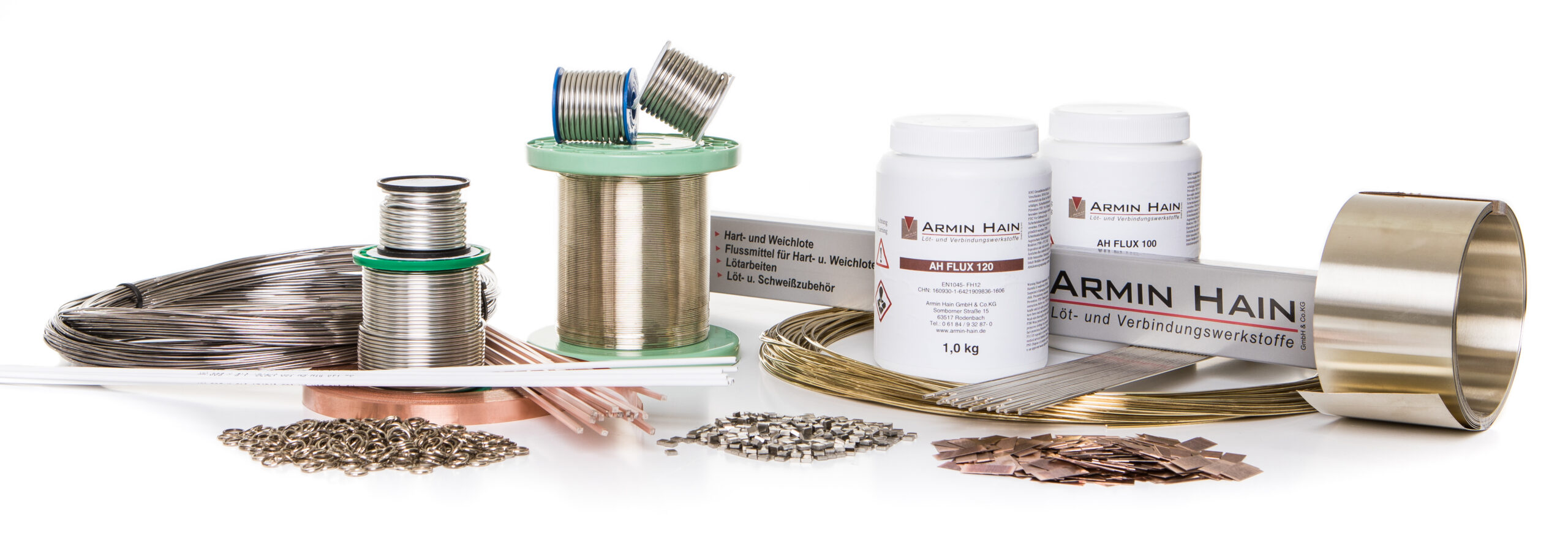
Beyond our contract brazing services, Armin Hain also supplies the filler metals behind them: braze alloys for high-strength, high-temperature joints, soft solders for applications below 450°C such as drinking water, heating and electronics, and the matching flux for both. Which material is right depends on your base metal, joint design, operating temperature and any applicable standards — we’re happy to help you find it.
Braze alloys (hard solders)
Silver braze alloys, phosphorus-copper alloys, special and hardmetal alloys, preforms and silver-based pastes — for stainless steel, copper, brass, nickel, steel, aluminium, carbide and chrome.
Soft solders
Lead-free and leaded solders for drinking water and heating (DVGW, DIN EN ISO 9453), electronics (RoHS-compliant, e.g. SAC305) and roofing or plumbing work.
Flux for both
Matching flux for braze alloys and soft solders, classified by working-temperature range (DIN EN 1045) and selected for your base metal and joining method.
Looking for the right filler metal?
Tell us your base metal, joint design and operating requirements, and we’ll help you find the right braze alloy, solder or flux. Please request a quote — we don’t list individual products online.
Special Brazing Alloys for Demanding Applications
Standard filler metals cover the majority of brazing tasks, but some applications call for something more specific. Depending on the base material combination, joint gap, working temperature, corrosion resistance, mechanical load and production process, a special filler metal alloy can be the more reliable choice. We help you assess these factors and select an alloy that matches the real requirements of the joint, rather than a generic material label.
Zinc-Free Silver Brazing Alloys
Zinc-free silver brazing alloys are suited to demanding joints processed under atmosphere with flux, as well as flux-free furnace brazing in protective-gas and vacuum furnaces. For stainless steel, we typically recommend the AG160 filler metal together with FH12 flux, which helps reduce the risk of knife-line corrosion that can occur with zinc-containing silver alloys under certain conditions. In vacuum brazing, temperatures above roughly 900 °C should be avoided to prevent silver from evaporating out of the joint. Zinc-free silver alloys are available in AH and BrazeTec quality; further alloys can be supplied on request.
Brass Filler Metals: An Economical Option for Robust Joints
Brass filler metals are copper-zinc based alloys that, depending on the application, can offer a cost-effective route to robust brazed joints. They are commonly used for steel, copper, brass, cast iron and bronze, including steel pipe frames, galvanized steel pipes and general steel or copper-alloy fabrications. As with any filler metal, suitability depends on the specific material combination, joint gap, component geometry and heating method rather than the base material alone.
Melting Range and Standards
Our brass filler metals are supplied in AH and BrazeTec quality. AH Ms 60 (Hartlot Cu 670) has a melting range of approximately 890–900 °C and corresponds to DIN EN ISO 17672: Cu 670, DIN EN 1044: CU 303 and DIN 8513: L-CuZn40Sn. AH NS 48 (Hartlot Cu 773) melts at approximately 890–920 °C and corresponds to DIN EN ISO 17672: Cu 773, DIN EN 1044: CU 305 and DIN 8513: L-CuNi10Zn42. As brass filler metals generally work at a higher temperature range than many silver brazing alloys, torch power, heating strategy and surface preparation need to be planned accordingly – and a suitable flux is essential to protect against oxidation on steel, brass, bronze and cast iron.
Brass or Silver Filler Metal – How to Decide
Brass filler metal is often the right call when cost-efficiency matters, the base materials are steel, copper, brass, cast iron or bronze, the application is robust and industrial in nature, and a higher process temperature is acceptable for the component. A silver-based alloy tends to be the better fit when heat input must stay low, the joint gap is very tight, capillary flow needs to be excellent, or the component is heat-sensitive – for example in some of the induction brazing under protective atmosphere work we carry out. Whichever alloy fits best, we’re glad to work through the technical details with you – get in touch to discuss your application, or see our Brazing Glossary and Brazing FAQ for more background.