
Contract Brazing Case Studies
Real projects, real outsourcing decisions. Below are two examples of how manufacturers across Europe have used our contract brazing expertise to solve production problems they couldn’t solve in-house – from a demanding diamond-tool application to a recurring production failure.
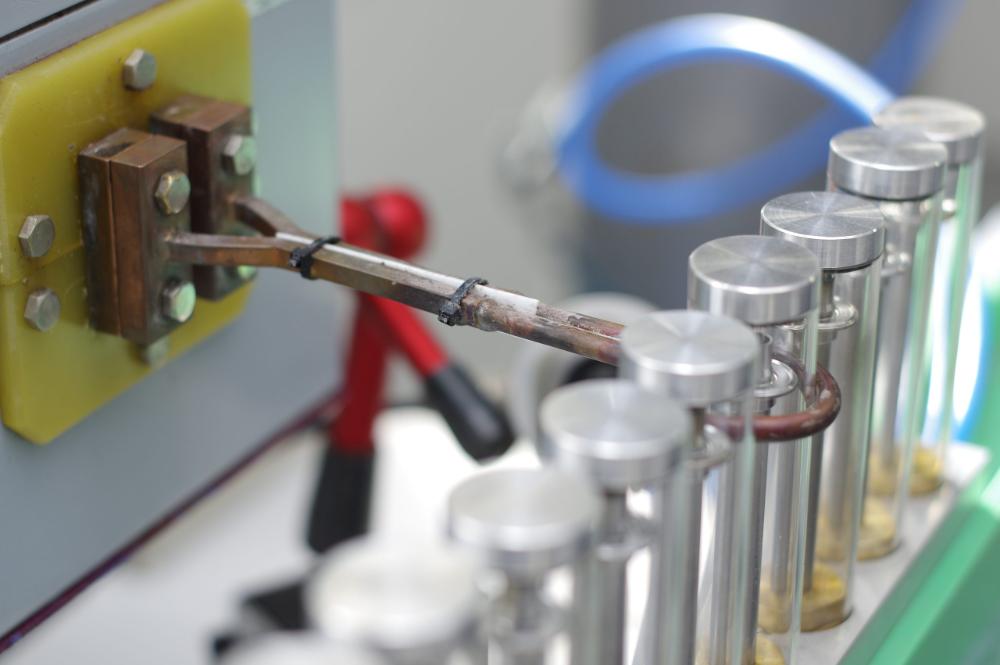
Induction Brazing for PCD Diamond Tools – Astillo Technologies (France)
The challenge: Astillo Technologies, based in Alsace, France, designs and manufactures machines and tools for surface preparation. For its polycrystalline diamond (PCD) tools, Astillo needed a contract brazing partner able to bond the diamond segments with maximum bond strength and tool life – a notoriously narrow process window, since the working temperature of the filler metal and the maximum temperature the diamond can tolerate sit very close together.
Our approach: In our in-house brazing lab, we developed a dedicated process over several trial runs: the tungsten carbide carrier is wetted with our AH Flux 120 flux and placed on a precisely cut filler-metal preform beneath the PCD blank, so the filler metal flows from the inside out and no flux inclusions form in the bonded area. The assembly is then induction-heated with PLC-monitored temperature control to a brazing temperature of 690°C for a process-safe, repeatable bond.
The result: We achieved the maximum bond strength Astillo required – the decisive award criterion for this project. Production has run reliably at our facility since 2016, with a largely automated, pyrometer-monitored brazing process that gives Astillo consistent tool quality on every batch.
Read more about this process on our PCD/CBN/PCBN brazing page.
Induction Brazing Solves a Recurring Production Failure – FTK Förderband Technik Kilian GmbH (Germany)
The challenge: FTK Förderband Technik Kilian GmbH, based in Bottrop, Germany, produces conveyor belt cleaning systems using a carbide-tipped scraper segment that can heat to over 200°C and cool again within seconds during operation. Adhesive-bonded and self-brazed versions of the joint kept failing prematurely, forcing early replacement of the segment and driving up scrap and downtime.
Our approach: We identified that flame brazing could not deliver the localised, controlled heating this component needed, and ran trials in our brazing workshop switching to induction brazing with a different filler metal from our own production. The combination proved reliable, and we brought the process to series-production readiness with a pilot batch – then took over full production, saving FTK the investment in its own induction brazing equipment.
The result: The induction-brazed joint significantly reduced scrap on this hard-metal-to-carrier bond and gave FTK’s customers longer, failure-free operation of their scraper systems – a direct competitive advantage, delivered without FTK having to invest in brazing equipment of its own.
Read more about outsourcing your production to us on our brazing outsourcing & series production page.
Have a brazing challenge of your own? Get in touch and tell us about your application – we’re happy to discuss feasibility, even for complex or unusual joints.